 Skip-the-line available
 Reading the house: colour, light and the walls
A room-by-room way of looking at Casa Luis Barragán, from the blank street wall to the coloured walls of the roof.
Casa Luis Barragán does not explain itself. There are no labels on the walls and very little to read, and the house works on you through sequence, light and colour rather than through information. That is exactly why it rewards a little preparation. This guide walks through the house in the order you meet it and points out what to look for in each space, so that when you are standing in the pink vestibule or under the open sky of the roof terrace, you know what Barragán was doing to you.
The wall that gives nothing away
Start outside, on General Francisco Ramírez. The house's own description calls the façade austere, almost unfinished: plastered concrete in its natural colour and rough texture, painted only at the doors for people and cars and at the window ironwork. High on the upper left corner, two planes meet in yellow and orange. A translucent library window, a grid of small panes, projects from the wall. Above it all rises a white tower that held the water tank.
It is easy to walk past. That is the point. Barragán built in Tacubaya, then a working neighbourhood, and he chose to give the street almost nothing. Everything the house has to offer is kept behind the wall. Take a moment on the pavement before your time, because the contrast between this blank face and what is inside is the first lesson of the visit.
The dark hall
You go in through a narrow, low entrance hall. It is dim after the street, the floor is volcanic stone and the walls are plain. Writers on the house have called it a decompression chamber, a space that makes you leave the city behind before anything else happens.
Give your eyes time here. The visit is built on contrast, and the hall is the dark half of it. If you hurry through, the next room loses half its effect.
The pink vestibule and the gold
The hall opens into the vestibule, the room most people remember. Light falls from a high window you cannot see directly. It strikes a gold-leaf painting by Mathias Goeritz, Barragán's friend and collaborator, then runs down a stair of dark stone onto a wall painted a deep pink. Accounts of the house describe a vestibule of yellow light and fuchsia walls; in person the effect is warm, still and slightly unreal.
Notice how little is in the room. A stair, a wall, a painting, a small table and chair, the light. The colour does the work that furniture or ornament would do elsewhere. Notice too that you are not shown where the light comes from. Barragán often hid his windows, so that you see the light before you see its source.
The living room and the garden window
From the vestibule you pass into the living room, and the scale changes completely. The ceiling rises to double height under wooden beams, and one whole side of the room is a huge window onto the garden. After the hall and the vestibule it feels like stepping outdoors.
Look at what the window frames. The garden is deliberately wild, more like a patch of overgrown woodland than a lawn, and it is surrounded by high walls so that nothing of the city shows. Writers on the house single out a pirul, a Peruvian pepper tree, as its heart. Barragán designed the garden to be looked at from the rooms as much as to be walked in, so the window is placed and proportioned like a painting on the wall.
Then look at the window itself. Its frame is pared down to a few thin bars, and its proportions match the wall. Many people find that they stop in front of it without being told to.
The library and the stair without a railing
The library sits next to the living room, divided from it by a wall that stops short of the ceiling, so the two spaces share air and light without merging. The shelves hold Barragán's books, part of a collection of some 3,000 publications kept in the house.
Here is the library's famous feature: a wooden stair with no railing, its treads projecting from the wall, rising to a small door high above. It is a simple idea taken to its limit. Without a railing, the stair becomes a sculpture against the white wall, and the room seems to hold its breath around it.
The stair also shows something about how Barragán thought of the house. It is not a grand staircase; it is barely wide enough for one person. Like much of the house, it was made for the life of a man who lived alone, and it trades convenience for an effect.
The garden
The garden is the part of the house you see most and enter least. It sits behind the living room, roughly as large as the house itself, and it is enclosed by high walls so that nothing of the street or the neighbours shows over them.
It is not a formal garden. Barragán let it grow wild, with dense planting, climbing greenery and old trees, including the pirul that writers on the house treat as its heart. The effect from inside is of a clearing in a wood rather than a city plot.
Notice how the garden is presented to you. From the living room, the big window turns it into a single framed view. Elsewhere in the house, smaller windows show only a slice of green. Barragán treated the garden less as a place to walk than as the main thing to look at, and he placed the windows accordingly. The garden is outdoors, so like the roof it is not opened to visitors in the rain.
Rooms for rest and prayer
The private rooms upstairs are quieter in tone. Writers on the house point out the cross-shaped shutters in the guest room, where the shutters form a cross, and a dressing room known as the Cuarto del Cristo, the Room of Christ, for the crucifix it holds. Barragán was a devout Catholic, and religious objects appear throughout the house, among paintings and ceramics from many centuries of Mexican art.
Look for the way light enters these rooms through shutters and small openings rather than wide glass. After the openness of the living room, the house closes in again, and the private rooms feel almost monastic.
The roof terrace
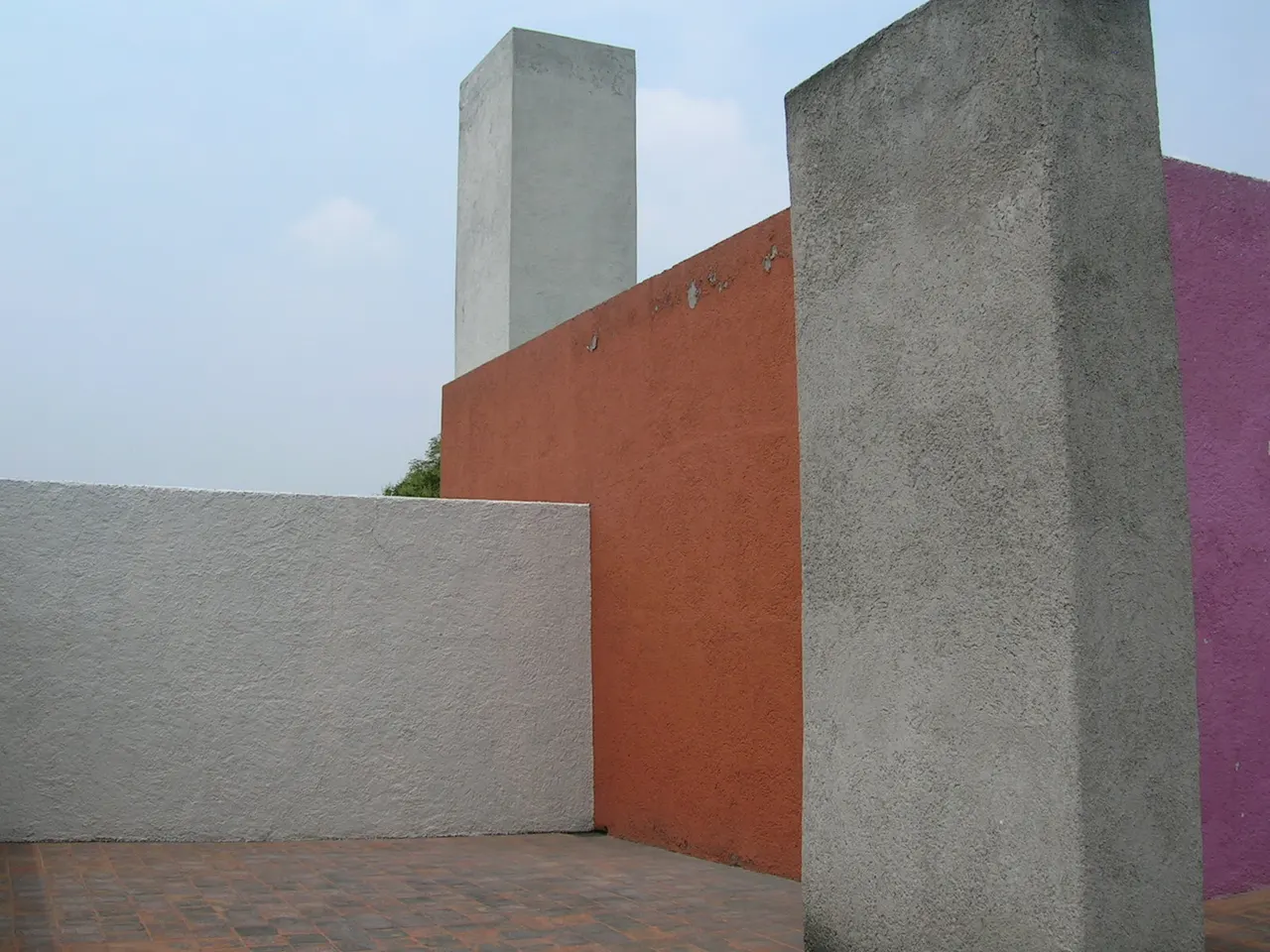
The visit ends, for many, on the roof. Here Barragán built a terrace closed in by high walls painted in strong colours, described as blood red, dark grey and white, with some writers noting a fuchsia wall. The walls are tall enough to hide the city entirely. All that is left is the floor, the colour and the sky.
This is the clearest statement of his idea of the enclosed garden. On the roof there is no garden at all, only the sky treated as a ceiling and the walls treated as planes of colour. Look at how the colours change as clouds pass, and how the white tower of the water tank appears over the top of the walls like a piece of sculpture.
Remember that the roof is outdoors. If it rains, the house does not open its outdoor spaces, and that can include the terrace.
The workshop at number 12
The building is two houses joined. Barragán's residence was at number 14 of the street, and the door to the north, at number 12, led to his workshop, where he worked for the rest of his career. UNESCO lists the property as a house and studio for that reason: the place where he lived and the place where he designed sit side by side, sharing the same walls and the same garden.
Seen from the street, the two doors look almost identical. Inside, the difference is one of use rather than style. The house is about rest and contemplation, the workshop about work, yet both follow the same rules of plain walls, controlled light and very few things. It is a reminder that Barragán did not keep a separate, showier manner for clients. The architecture he lived in was the architecture he made.
What photographs cannot show
Most people arrive having seen pictures of the pink vestibule and the library stair, and the pictures are accurate. What they cannot show is scale and sequence. The rooms are smaller than they look in photographs, the hall darker, the transitions sharper. The feeling of the house comes from walking from one space into the next, not from any single view.
Colour as a material
Barragán's colours are what most people know him for, and the house shows how he used them. They are not decoration added to a finished room. They are part of how a room is made: a pink wall that warms a dark stair, a yellow plane on the façade that catches the sun, a red wall on the roof that turns the sky a deeper blue.
The painter Jesús Reyes Ferreira, known as Chucho Reyes, influenced his use of colour, and the collaboration with Goeritz shaped his sense of colour as a field rather than a detail. The colours are not soft. Its colour schemes are often called strongly non-harmonic, and that is accurate: they clash on purpose, and the clash keeps the plain rooms alive.
How to look on the day
Slow down at every change of light. The house is a sequence of dark and bright, closed and open, and the effect depends on noticing the change as it happens.
Look up. Many of Barragán's windows are high, hidden or angled, and the light arrives before you see where it comes from.
Look down. Floors change from volcanic stone to wood as you move from the public spaces to the living ones.
Look at the walls as surfaces. The plaster is not smooth, and the texture holds the light differently through the day.
And keep quiet. Small groups, flat shoes and a hushed voice are part of the house's rules, but they are also the best way to see it. The house was designed around silence, and it is at its best when it is quiet.
Frequently asked
What is the pink wall in Casa Luis Barragán?
The vestibule beside the entrance hall, where light from a high window falls on a gold-leaf painting by Mathias Goeritz and down a stair onto a wall painted deep pink.
Does the library stair really have no railing?
Yes. The wooden stair in the library rises against the wall with no railing, its treads projecting from the wall, which is why it reads like a sculpture.
Can you visit the roof terrace?
The roof terrace is part of the house, but it is outdoors, and the house does not open outdoor spaces when it rains. Access to any space can also be restricted for maintenance or safety.
Why is the outside of the house so plain?
Barragán turned the house inward. The street façade is rough plastered concrete with almost no colour, and everything else is kept behind it, around the rooms, the walled garden and the sky.